In today’s hyper-connected digital landscape, data is being generated at an unprecedented rate. Every click, transaction, social media interaction, and IoT device contributes to a vast ocean of information. This massive volume of structured and unstructured data is what we call Big Data.
For modern businesses, Big Data is not just a buzzword—it’s a powerful asset that can drive smarter decisions, improve customer experiences, and create a significant competitive advantage. Companies that understand and leverage Big Data effectively are better positioned to innovate, scale, and thrive in an increasingly data-driven world.
This comprehensive guide explores what Big Data is, its core components, how it works, and why it is essential for businesses in 2026 and beyond.
What Is Big Data?
Big Data refers to extremely large and complex datasets that traditional data processing tools cannot efficiently handle. These datasets are generated from various sources such as:
- Social media platforms
- Online transactions
- Sensors and IoT devices
- Mobile applications
- Business operations and systems
The defining characteristic of Big Data is not just its size, but also its complexity and speed of generation.
The 5 Vs of Big Data
To better understand Big Data, it is often described using the “5 Vs” framework:
1. Volume
This refers to the massive amount of data generated every second. Businesses today deal with terabytes or even petabytes of data.
2. Velocity
Velocity is the speed at which data is generated, processed, and analyzed. Real-time data processing is critical for many applications such as fraud detection and live analytics.
3. Variety
Data comes in many forms:
- Structured (databases, spreadsheets)
- Semi-structured (XML, JSON)
- Unstructured (videos, images, text)
4. Veracity
This refers to the accuracy and reliability of data. Poor-quality data can lead to incorrect insights and bad decisions.
5. Value
Ultimately, the goal of Big Data is to extract meaningful insights that provide value to businesses.
Types of Big Data
Structured Data
Highly organized data stored in relational databases. Example: customer records.
Unstructured Data
Data without a predefined format, such as videos, emails, and social media posts.
Semi-Structured Data
Data that does not fit neatly into tables but still contains tags or markers (e.g., JSON files).
How Big Data Works
Big Data involves a combination of technologies and processes:
Data Collection
Data is gathered from multiple sources such as websites, apps, sensors, and CRM systems.
Data Storage
Big Data is stored using distributed systems like data lakes and cloud storage platforms.
Data Processing
Technologies like distributed computing frameworks process large datasets efficiently.
Data Analysis
Advanced analytics tools and algorithms are used to uncover patterns, trends, and insights.
Data Visualization
Insights are presented through dashboards, charts, and reports to support decision-making.
Key Technologies Behind Big Data
Modern Big Data ecosystems rely on several powerful technologies:
Hadoop
An open-source framework that allows distributed storage and processing of large datasets.
Spark
A fast data processing engine designed for real-time analytics.
NoSQL Databases
Databases like MongoDB and Cassandra that handle unstructured data efficiently.
Cloud Computing
Platforms like AWS, Azure, and Google Cloud enable scalable Big Data storage and processing.
Machine Learning
AI-driven algorithms that analyze data and generate predictive insights.
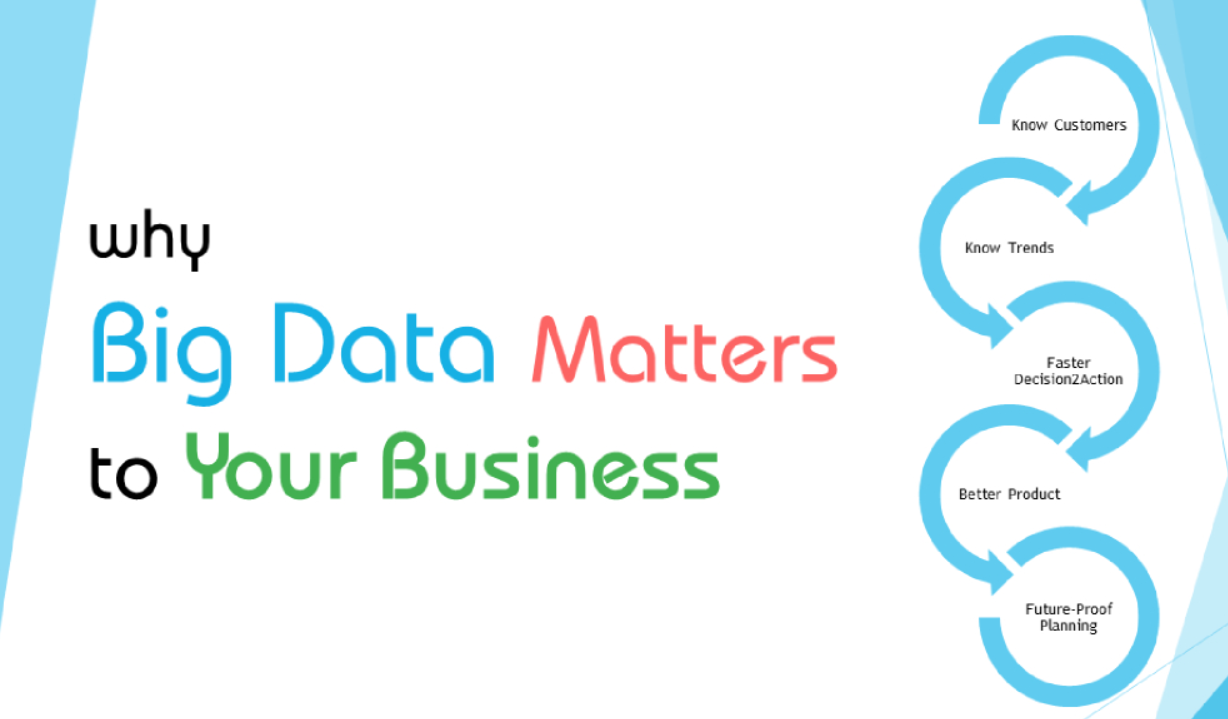
Why Big Data Matters for Modern Businesses
Big Data has become a cornerstone of business success in the digital age. Here’s why it matters:
1. Better Decision-Making
Big Data enables businesses to make data-driven decisions instead of relying on intuition.
Example:
- Predicting customer demand
- Identifying market trends
- Optimizing pricing strategies
With accurate insights, companies can reduce risks and improve outcomes.
2. Improved Customer Experience
Understanding customer behavior is crucial for success. Big Data allows businesses to:
- Personalize marketing campaigns
- Recommend products
- Improve customer service
Companies like e-commerce platforms use data to tailor experiences for each user.
3. Increased Operational Efficiency
Big Data helps streamline operations by identifying inefficiencies.
Benefits include:
- Supply chain optimization
- Predictive maintenance
- Resource allocation
This leads to reduced costs and improved productivity.
4. Competitive Advantage
Businesses that leverage Big Data can outperform competitors by:
- Identifying new opportunities
- Responding quickly to market changes
- Innovating faster
Data-driven organizations are more agile and adaptable.
5. Risk Management and Fraud Detection
Big Data plays a critical role in identifying and preventing risks.
Applications:
- Fraud detection in banking
- Cybersecurity monitoring
- Compliance tracking
Real-time analytics can detect anomalies and prevent losses.
6. Product and Service Innovation
Big Data helps businesses understand what customers want.
This enables:
- Development of new products
- Improvement of existing services
- Faster time-to-market
Innovation driven by data is more aligned with customer needs.
Real-World Applications of Big Data
1. Retail
Retailers use Big Data for inventory management, customer segmentation, and personalized marketing.
2. Healthcare
Big Data improves patient care through predictive analytics and personalized treatment plans.
3. Finance
Banks use Big Data for fraud detection, risk assessment, and algorithmic trading.
4. Manufacturing
Manufacturers use data for predictive maintenance and process optimization.
5. Marketing
Marketers analyze customer behavior to create targeted campaigns and improve ROI.
Challenges of Big Data
Despite its advantages, Big Data comes with challenges:
Data Privacy and Security
Protecting sensitive data is a major concern.
Data Quality
Inaccurate or incomplete data can lead to poor decisions.
Complexity
Managing and analyzing large datasets requires specialized skills and tools.
Cost
Implementing Big Data infrastructure can be expensive.
How Businesses Can Get Started with Big Data
If you’re new to Big Data, here’s a step-by-step approach:
1. Define Clear Objectives
Identify what you want to achieve with data.
2. Collect Relevant Data
Focus on gathering high-quality, relevant data.
3. Choose the Right Tools
Select tools and platforms that fit your needs and budget.
4. Build a Skilled Team
Hire or train professionals in data science and analytics.
5. Start Small and Scale
Begin with pilot projects and expand as you gain experience.
Big Data and Artificial Intelligence
Big Data and AI go hand in hand. AI systems rely on large datasets to learn and improve.
Key benefits:
- Predictive analytics
- Automation
- Intelligent decision-making
The combination of Big Data and AI is transforming industries worldwide.
The Future of Big Data
As technology continues to evolve, Big Data will become even more critical.
Trends to watch:
- Real-time analytics
- Edge computing
- Data democratization
- Increased use of AI
Businesses that invest in Big Data today will be better prepared for the future.
Best Practices for Leveraging Big Data
To maximize the benefits of Big Data:
- Ensure data quality and accuracy
- Prioritize data security
- Use scalable infrastructure
- Focus on actionable insights
- Continuously monitor and improve
Conclusion
Big Data is no longer optional—it is essential for modern businesses aiming to stay competitive in a rapidly evolving digital economy. By harnessing the power of data, companies can make smarter decisions, enhance customer experiences, and drive innovation.
However, success with Big Data requires more than just technology. It demands a strategic approach, skilled professionals, and a commitment to data-driven culture.
As we move further into 2026 and beyond, businesses that embrace Big Data will not only survive but thrive in the age of information.
FAQs
What is Big Data in simple terms?
Big Data refers to extremely large datasets that can be analyzed to reveal patterns, trends, and insights.
Why is Big Data important for businesses?
It helps businesses make better decisions, improve efficiency, and gain a competitive advantage.
What industries use Big Data?
Almost all industries, including retail, healthcare, finance, and manufacturing.
Is Big Data expensive to implement?
It can be costly initially, but cloud solutions have made it more accessible for businesses of all sizes.
How can small businesses use Big Data?
By using analytics tools, customer data, and cloud platforms to gain insights and improve operations.